Axel’s cover identity as Rufus
Down Cemetery RoadAxel Crane’s cover identity as Rufus lets him pass as an inconsequential, affectionate family man while concealing his real name and purpose. Its force lies in how thoroughly it enters other people’s lives: he is not simply called Rufus but lives as Wigwam’s husband for six months, and Sarah Trafford recalls that the persona had helped make a real man easier to trap. His unmasking turns an apparently harmless acquaintance into a threat and forces Sarah to reconsider what she thought she knew about both him and Wigwam.
The Rufus persona
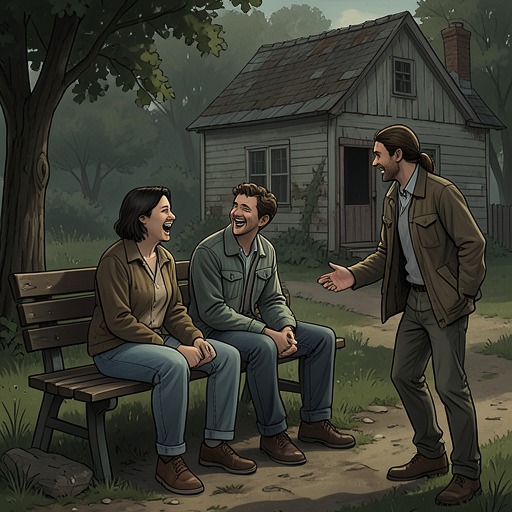
Rufus first appears to Sarah as a figure so unremarkable that his past seems to have no shape. In retrospect, she cannot remember how he arrived in Wigwam’s life; he seems simply to have appeared, like a harmless hippie who had dropped out of a Christmas cracker. The apparent absence of a history is part of what makes the disguise effective. Sarah had known him socially as Rufus, but the person she thought she knew had no accessible past against which to test his story.
That apparent harmlessness coexisted with a capacity for menace. When Sarah challenges him over the night the bomb went off, Rufus mocks the idea that he had been there to protect her, then acknowledges that he turned up late. His grinning, childlike “Peep-oh!” offers no reassurance: it makes playfulness and threat difficult to separate. Sarah’s question, “Who are you?”, receives no stable answer at first. The name Rufus is an invitation to accept the persona, not an explanation of the person behind it.
The unmasking before Sarah
Rufus eventually answers Sarah directly: “But my real name’s Axel.” He briefly imitates Gerard Inchon, turning his face into a pompous mask to repeat the insult he imagines Gerard would make about the name. The performance adds another layer to the revelation: even while disclosing his identity, Axel Crane remains a practiced mimic, able to put on a face and take it off again. Rufus is not exposed by an accidental slip; Axel announces the distinction between his adopted name and his real one while continuing to perform.
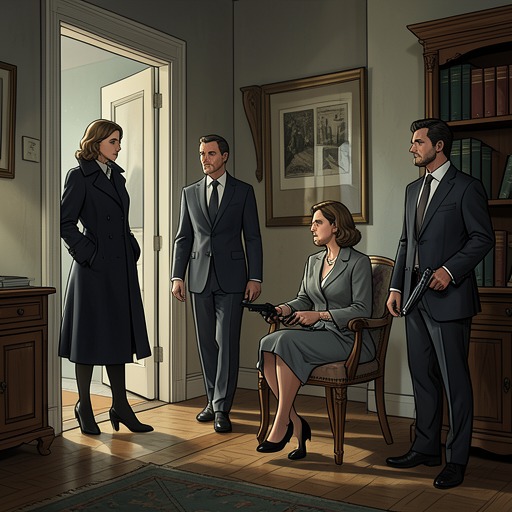
He then describes himself to Sarah as “your bad dream,” a creaking stair and a light going out without warning. The images make his presence feel less like an ordinary confrontation than a danger that has already entered the house of her life. He has Sarah’s copy of Joe Silvermann’s letter, marked in red with her intentions visible. Holding it, he confronts her with the fact that Joe is dead and has been framed, and with the police’s suspicions about her. His questions about the letter and the phone number show that he understands Sarah’s attempt to pursue the matter and wants her to stop. He insists that she had been supposed to give it up; her claim that she has already done so does not end the confrontation.
The threat beneath the performance becomes explicit when he tells her, patiently, that he is going to kill her. Sarah appeals to the possibility that Wigwam will find out and tell someone. Axel responds that he does not care, and says that he would have left weeks earlier if Sarah had not been there. He describes spending six months married to Wigwam with open contempt. The revelation therefore joins the false identity to immediate coercion: the man who had passed as a husband now treats that marriage as an unwanted interval and Sarah as an obstacle.
Marriage as cover
Sarah’s later understanding of Rufus depends on the gap between his public role and his purpose. He had presented himself as Wigwam’s lover and husband, but Sarah concludes that the domestic performance was cover for an attempt to catch Thomas Singleton when he returned. In her account, Thomas had died because he could not stay away from his wife and daughter; Rufus had been posing as a family man in order to trap a real one. The impersonation is consequently more than camouflage for Axel Crane as an individual. It inserts a fabricated family life into the life of another household, exploiting the possibility that Thomas would return to the people he loved.
The disguise also belongs to a wider effort to control what others believe about Thomas. In the discussion of what to tell Thomas’s wife, the proposed answer is not that he is dead but that he is a terrorist: a story that recasts a husband of six months as a wanted criminal who married only to maintain cover. The exchange frames the domestic persona and the public cover story as complementary deceptions. One makes the false husband plausible to those around him; the other is intended to make Thomas’s disappearance or death intelligible on terms that conceal the real operation.
What the disguise leaves behind
The exposure does not give Sarah certainty about everything Rufus did. She cannot tell whether Wigwam is alive, and questions why Rufus would have wanted her to believe Wigwam was already dead if he had not killed her. The disguise has made even the report of Wigwam’s death suspect. Sarah’s uncertainty matters: learning Axel Crane’s name reveals the fraud, but it does not restore reliable knowledge of the people caught inside it.
Nor does the revelation erase the real attachment that may have existed within the false marriage. Sarah reasons that, if Wigwam is alive, she will grieve for Rufus despite what he has done and whoever he proves to be. For six months, he had pretended to be Wigwam’s lover; Sarah sees that no man had cared for Wigwam enough in the past to sustain such a pretense for so long. This does not make Axel Crane’s assumed identity truthful, or excuse the violence attached to it. Instead, it leaves Sarah with a painful distinction: a relationship can be built on deception and still produce something that matters to the person deceived. As the train carries her onward, she grieves not simply for the dead but for the living whose identities and attachments have been made uncertain.